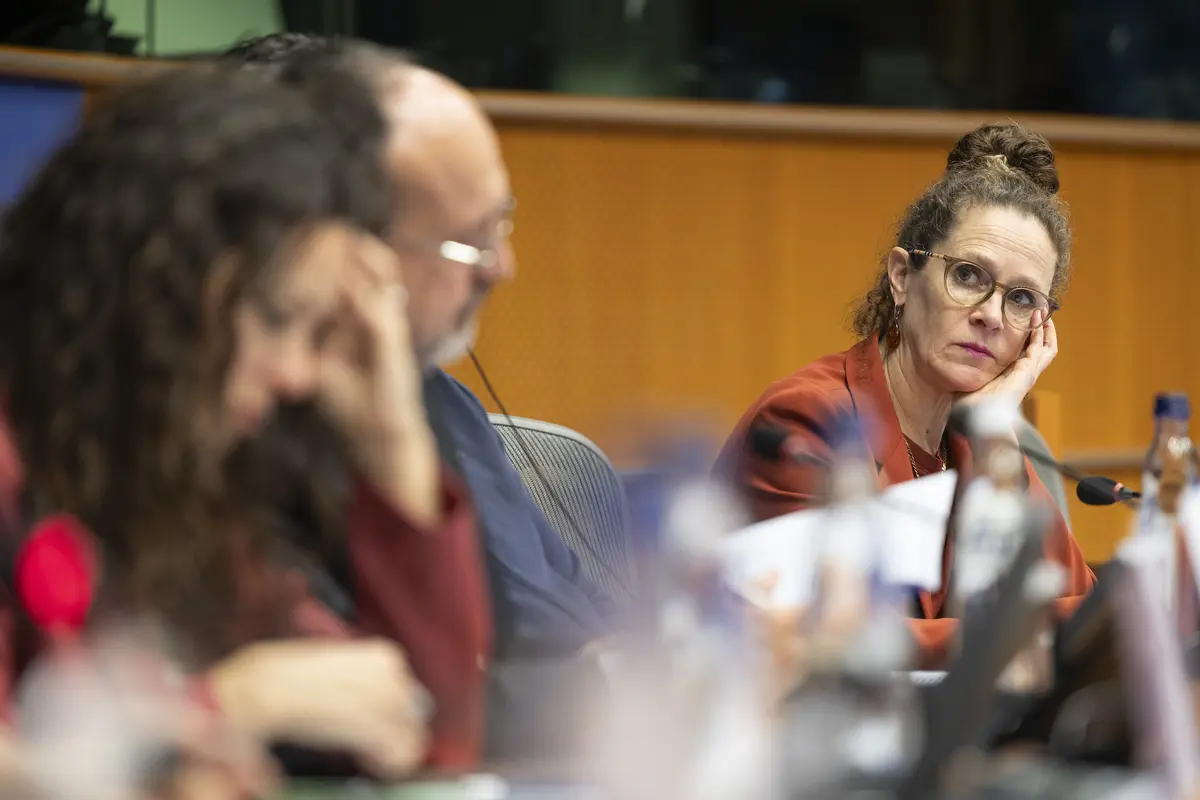

As Slovakia continues to follow the third trial of those accused of ordering the murder of investigative journalist Ján Kuciak and his fiancée Martina Kušnírová, the killings of journalists across Europe continue to cast a shadow over the European Union’s commitment to press freedom and the rule of law. Years later, many of those wounds remain open, says former Volt MEP Sophie in ’t Veld.
Is the European Union doing enough to protect journalists and ensure justice? BraveNews.eu asked in ‘t Veld, a former chair and vice-chair of the European Parliament’s Committee on Civil Liberties (LIBE) and former leader of the special committee investigating Pegasus and other spyware (PEGA).
“It depends who is in power. Some political groups are very vocal about certain cases but silent about others. In Greece, for example, there has been far less pressure,” she says, referring to the 2021 murder of crime reporter Giorgos Karaivaz in Greece. “The EPP doesn’t want to say anything. They’re trying to get the European Parliament to shut up about it.”
Rule of law enforcement, in many cases, has become entangled in political bargaining between governments. “The European Commission may hesitate to act firmly against one leader if it needs their support on another issue,” in ‘t Veld adds.
Following the 2018 assassination of Slovak journalist Ján Kuciak and his fiancée Martina Kušnírová, the European Parliament sent an ad hoc delegation led by in ‘t Veld. Their murders came just four months after Maltese journalist Daphne Caruana Galizia was killed. “The same EPP has rightfully been so on top of the Daphne Caruana case,” says in ‘t Veld.
The shock of these killings forced MEPs to confront a troubling reality: these were not isolated incidents. “This was not something that was a one-off,” in ‘t Veld explains. The events led directly to the creation of the European Parliament’s Democracy, Rule of Law and Fundamental Rights Monitoring Group (DRFMG). “There is a very direct connection between those murders and the systematic monitoring of rule of law in several member states,” says in ‘t Veld, who chaired the monitoring group from 2018 to 2024.
Yet justice remains incomplete. In Slovakia, attempts to convict the mastermind behind Kuciak’s murder have faltered. While the gunmen are imprisoned, full accountability has proved elusive. Meanwhile, political power has shifted back to figures associated with the climate Kuciak investigated, raising concerns about pressure on courts and prosecutors.
In Malta, five persons have been found guilty of the 2017 assassination of Caruana Galizia, including those who supplied, planted and detonated the car bomb. However, the alleged mastermind, Jorgen Fenech, a powerful Maltese businessman, is still awaiting trial. Worryingly, a court order has banned journalists from reporting on the legal proceedings.
If killing is not enough to intimidate journalists, what is?
In Greece, the 2021 murder of Giorgos Karaivaz remains unresolved, despite alleged links to organized crime and possible political connections. In Bulgaria, the killing of Viktoria Marinova sparked international concern, though unclear motives complicated the case.
For in ‘t Veld, the pattern is clear: intimidation does not always require a bullet. Strategic lawsuits, political attacks on media, and the dismantling of independent prosecution services are part of what she calls the “playbook” used by leaders who hollow out democratic safeguards while maintaining formal electoral legitimacy.
“After Jan Kuciak’s murder in 2018, there was massive public outcry. Prime Minister Robert Fico stepped down. But he has since returned to power, and old patterns of corruption are re-emerging,” she warns.
Is the EU doing enough? Publicly, press freedom is celebrated in speeches and awards. But enforcement, she argues, is often sacrificed to political bargaining among member states. Rule of law concerns can be traded off in negotiations on budgets or foreign policy.
For the families of murdered journalists, the delay and dilution of justice is devastating. Their loss, in ‘t Veld suggests, should never become collateral damage in Europe’s political trade-offs. Press freedom is not a ceremonial value; without credible accountability, it remains a promise unkept.
Edited Transcript of Interview with Sophie in ’t Veld
BraveNews.eu: After Daphne Caruana Galizia’s murder, the European Parliament sent a delegation to Malta. Then four months later, Ján Kuciak and his fiancée were killed in Slovakia. You were part of that delegation. What changed after those events?
Sophie in ’t Veld: After those two murders, we in the European Parliament realized this was not a one-off. It led directly to the creation of the Rule of Law Monitoring Group, which still exists today as a permanent committee. There is a very direct connection between those murders and the permanent monitoring of rule of law in several member states.
BraveNews.eu: Since then, there have been other high-profile cases?
Sophie in ’t Veld: Yes. In Bulgaria, Viktoria Marinova was murdered. It wasn’t exactly clear whether the motive was journalistic or personal. In April 2021, Giorgos Karaivaz was murdered in Greece. There are all sorts of alleged links to the ruling party, and the case remains unresolved.
In Slovakia, multiple attempts to convict Marian Kočner as the mastermind behind Kuciak’s murder have failed. There is still no closure.
BraveNews.eu: But people are on trial. Won’t there be justice?
Sophie in ’t Veld: I hope so, but there are reasons to worry. Kuciak was investigating corruption and organized crime linked to government circles. After his murder, massive public outcry obliged Prime Minister Robert Fico to step down. But a couple of years later, he’s back as if nothing happened. Old corruption patterns are re-emerging.
The question is whether there will be a serious, fair, and independent court process. There has been massive corruption exposed within the judiciary. Fico dismissed the special prosecutor handling corruption cases upon his return — clear interference. He’s interfering and silencing media.
BraveNews.eu: Is the EU doing enough to prevent journalists’ assassinations and bring murderers to justice?
Sophie in ’t Veld: It depends on who is in power. Some political groups are vocal about certain cases but silent about others. In Greece, for example, there has been far less pressure. The same EPP has rightfully been so on top of the Daphne Caruana case. In the case of Giorgos Karaivaz, was murdered in Greece, the EPP doesn’t want to say anything. They’re trying to get the European Parliament to shut up about it
BraveNews.eu: Why is this so?
Sophie in ’t Veld: The difficulty is with the way that government leaders have grabbed power in ultra-intergovernmental Europe. That means, they can bribe Hungarian prime minister Viktor Orban into lifting his veto for €90 billion for Ukraine. Let’s say the Commission comes down too hard on Fico, maybe he’ll block something else.
Rule of law enforcement often becomes entangled in political bargaining. Press freedom is always touted as a priority, but without consistent enforcement, those words ring hollow.
- Ján Kuciak Trial Continues as Former MEP Sophie in ’t Veld Warns EU on Press Freedom
- Mediahuis €7.8M Tender Fine: Euractiv Subsidiary Not Impacted
- Belgian Court Strikes Down Law Criminalizing Journalists’ Leaks
- Belgian Police Return UK Journalist David Price’s Laptops
- Why Europe Yielded to Trump — Dave Keating on The Owned Continent
