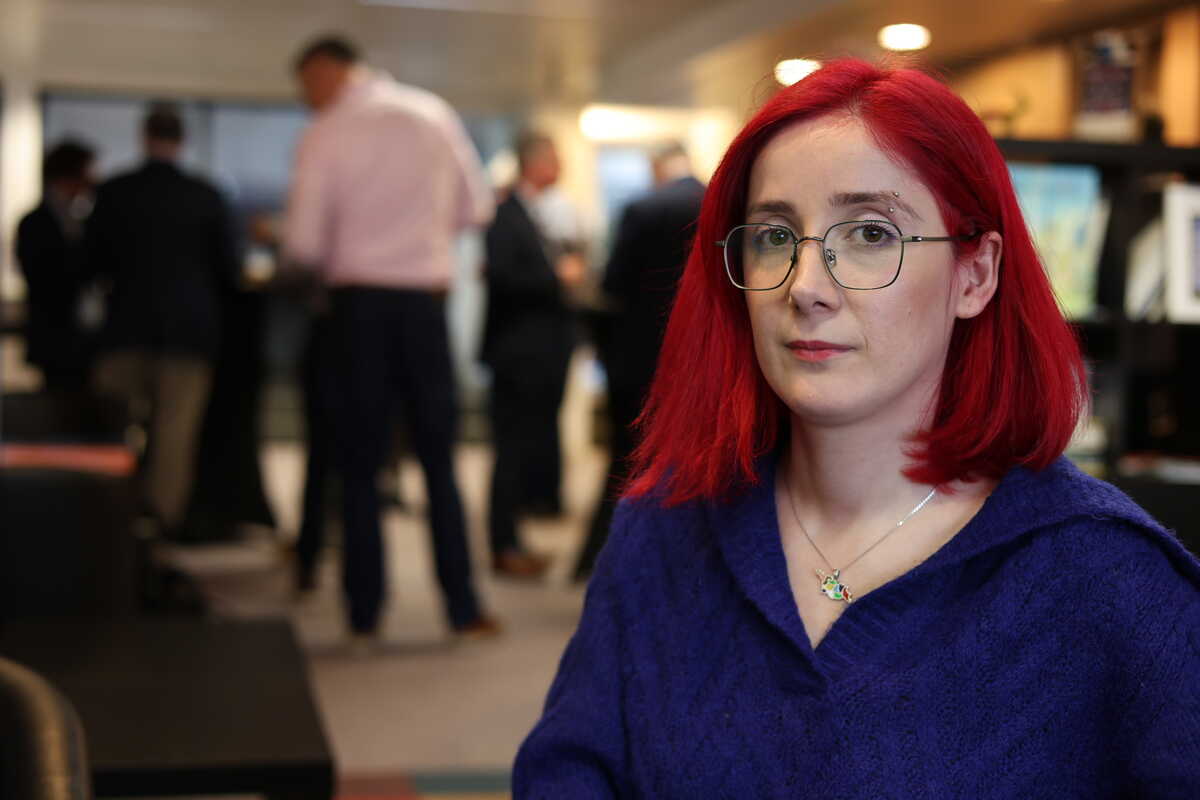

BRUSSELS — When Georgian journalist and 2025 Sakharov laureate Mzia Amaghlobeli was arrested in Batumi on January 12, 2025, she quickly became a symbol of the country’s embattled pro-democracy movement. More than a year later, Amaghlobeli remains in prison, serving a two-year sentence for “resistance, threats or violence against a defender of the public order.”
In her absence, Irma Dimitradze — a longtime colleague from the independent newsrooms Batumelebi and Netgazeti — has emerged as the public face of the international campaign to secure her release.
Dimatradze quickly focused on one goal: winning the European Parliament’s Sakharov Prize for Freedom of Thought for Amaghlobeli, believing it offered the strongest platform to mobilize international support.

Against the odds, and thanks to relentless determination and capacity to convince and cajole, the effort succeeded. In 2025, the European Parliament awarded the Sakharov Prize jointly to Amaghlobeli and Belarusian journalist Andrzej Poczobut, recognizing their work defending press freedom.
Bravenews.eu spoke with Dimitradze at the Brussels Press Club on March 3 after she addressed the launch of the annual report of the Council of Europe’s Platform for the Safety of Journalists. The conversation quickly turned to the people behind the campaign.
From reluctant intern to fearless journalist
Dimatradze says she never planned to become a journalist.
As a teenager, she applied for an internship at Batumelebi — a regional newspaper founded by Amaghlobeli in the Black Sea city of Batumi — largely to prove that journalism was not for her.
“I wrote in my application: ‘I don’t like journalism, and I want to prove that I don’t like it,’” Dimitradze recalled.
Amaghlobeli, however, was equally determined to prove the teenager wrong.
The experiment changed Dimitradze’s life. Although she enrolled at university to study finance, she began contributing to Batumelebi as a student, covering events and writing blogs.
“I got trapped into journalism,” she said.
Most of her career since then has been tied to Batumelebi and its online platform, Netgazeti, widely regarded as leading independent media in Georgia.
A newsroom under pressure
After a two-year break in China, Dimitradze returned in 2021 intending to work in management rather than reporting. Within weeks she was back in the field, including covering growing Chinese investment in the region.
She recalls one episode that captures Amaghlobeli’s determination. Convinced that a state security agent was blackmailing a colleague, Amaghlobeli spent nearly two years tracking him down with only a first name as a clue.
When she finally found him at his home, Dimitradze said, Amaghlobeli handed him a copy of the Georgian Constitution and told him it was to replace the one he must have lost.
“If she believes something is right — no matter how unimaginable or hopeless it seems — she goes for it,” added Dimitradze.
Batumelebi itself was founded with only a few hundred dollars. From the beginning, Dimitradze said, the newsroom saw its role as a form of public defense — holding authorities accountable and providing reliable information to citizens.
Even from prison, colleagues say Amaghlobeli continues to urge professionalism and ethical rigor in their reporting.
Financial pressure on independent media
Since Amaghlobeli’s arrest, Dimitradze has taken on a hybrid role — helping keep the newsroom running while campaigning internationally for her colleague’s release.
The newsroom’s survival has been a constant struggle.
According to Dimitradze, company bank accounts were twice frozen, and more than $50,000 seized. Salaries were cut in half, and several investigations had to be scaled back.
“It was not our best journalism,” she said. “But it was the best we could do.”
She believes the financial, legal and administrative pressure is intended to force independent outlets to shut down or move into exile.
New legislation proposed by the government could further tighten restrictions on media and civil society, she warned.
“A NATO for journalists”
The newsroom has survived largely because of the culture Amaghlobeli built — one Dimitradze describes as familial.
“She treats everyone as part of her family,” she said.
That solidarity has extended beyond a single newsroom. Journalists from competing Georgian outlets rallied behind Amaghlobeli, particularly during her five-week hunger strike in prison.
“For a moment,” Dimitradze said, “we became almost one newsroom in the country.”
Her message to European journalists is blunt: the case is not only about Georgia.
“This is a war on journalism itself,” she said.
Dimitradze argues that the profession needs stronger international solidarity mechanisms — something she half-jokingly describes as “a NATO for journalists.”
“If you don’t push back,” she warned, “we will all disappear.”
What began as a teenage act of defiance has become a vocation.
On the Sakharov campaign trail, Dimitradze once declared: “You only need courage when the situation is hopeless. Now is the time for great courage.”
Ironically, while there are still journalists like Mzia and Irma, there is always hope.
- EU Commission Spends €1.3mn on News Subscriptions
- Belgian Authorities Cleared Journalist After Security Ban Over Alleged ‘Extreme-Left Contacts’
- Irma Dimitradze Leads Campaign to Free Jailed Sakharov Laureate Journalist Mzia Amaghlobeli
- Eight Years After Jan Kuciak and Martina Kušnírová Murders, Slovakia Faces Critical Third Trial
- EU News Revenue Collapse from US Platforms and AI Search
